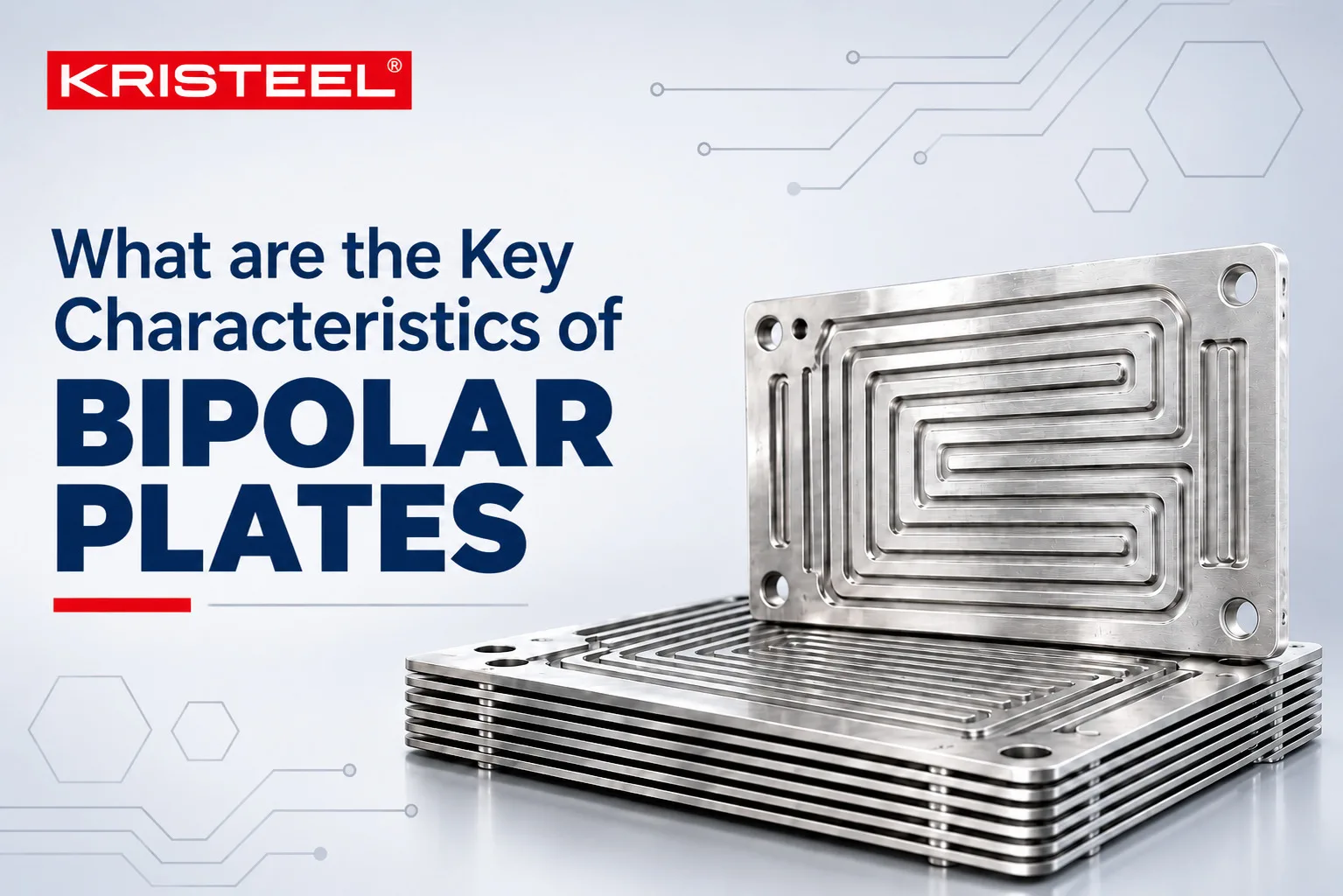
Bipolar plates are central to Proton Exchange Membrane (PEM) fuel cells and other fuel cell technologies. They connect individual cells within a stack, carry current from one cell to the next, and manage the flow of gases. Because bipolar plates perform several functions within the stack, their material, geometry, surface properties, and manufacturing method strongly influence overall system performance.
What Are Bipolar Plates?
A bipolar plate sits between two adjacent cells in a fuel cell stack. One side touches the anode of one cell, and the other side touches the cathode of the next. The plate does several jobs at once: it collects electrical current, distributes reactant gases, transfers heat, and supports water management.
Flow channels distribute hydrogen, air, or other reactants across the active area so the electrochemical reaction receives a more uniform supply. Machined or etched into the plate surface, they spread hydrogen, air, or other reactants across the active area of the cell, so the catalyst sees an even supply.
Key Characteristics of Bipolar Plates
Electrical Conductivity
Bipolar plates must conduct electricity efficiently from cell to cell. Low electrical resistance reduces energy losses inside the stack and protects overall efficiency.
Corrosion Resistance
Plates operate in demanding chemical and electrochemical environments, including acidic conditions. Resisting corrosion preserves conductivity, structural integrity, and reliability across the stack’s life.
Mechanical Strength and Durability
Durable plates maintain structural stability, electrical contact, and sealing performance over repeated operating cycles.
Gas Tightness
Plates keep reactant gases from leaking or mixing between separate flow paths. Precision manufacturing and effective sealing make that possible.
Thermal Conductivity
Bipolar plates carry heat away from the reaction zone and help manage temperature within the stack. Consistent thermal performance supports reliable operation.
Lightweight and Compact Design
Plate thickness, density, and overall dimensions drive stack size and weight. Lightweight designs matter most in automotive, portable, and stationary fuel cell applications.
Materials Used to Manufacture Bipolar Plates
- Graphite: It offers high electrical conductivity and corrosion resistance. Brittleness and machining difficulty limit its use.
- Metallic materials: Stainless steel, titanium, and other suitable alloys bring strength and thin profiles. Some applications need protective coatings.
- Composite materials: Graphite-polymer composites combine selected electrical, chemical, and mechanical properties.
Fuel cell type, operating conditions, production requirements, and cost steer the choice. At Kristeel, we manufacture bipolar plates using photochemical etching, a non-contact process that produces complex profiles without the mechanical stresses associated with conventional machining or punching.
Applications of Bipolar Plates

Bipolar plate applications include fuel cell vehicles, stationary power plants, backup power systems, and specialized industrial electrolyzers.
- Fuel cell vehicles: Plates shape stack performance for automotive use, offering a cleaner alternative to internal combustion engines.
- Stationary power generation: Fuel cell systems that provide electricity rely on them.
- Backup power systems: Selected backup and distributed power applications use them.
- Electrochemical systems: Certain electrolyzers and related technologies use bipolar plates, where design and material requirements may differ.
Portable electronics and aerospace also explore fuel cells that use bipolar plates.
Factors to Consider When Selecting Bipolar Plates
Selecting bipolar plates requires evaluating electrical resistance, corrosion resistance, mechanical strength, operating temperature, flow-channel design, coating requirements, manufacturing cost, and compatibility with the electrochemical system.
- Evaluate electrical resistance, corrosion resistance, mechanical strength, and gas-tightness.
- Consider operating temperature, pressure, chemical environment, and required service life.
- Review flow-channel design, plate thickness, surface finish, and manufacturing tolerances.
- Compare manufacturing costs, coating requirements, and compatibility with the intended electrochemical system.
Conclusion
Bipolar plates support fuel cell and electrochemical systems through electrical conductivity, corrosion resistance, mechanical strength, gas tightness, thermal management, and compact design. Balancing those traits against cost is the central design task. The ideal plate depends on the system design and operating requirements. For precision-etched plates, you can explore our bipolar plates at Kristeel.