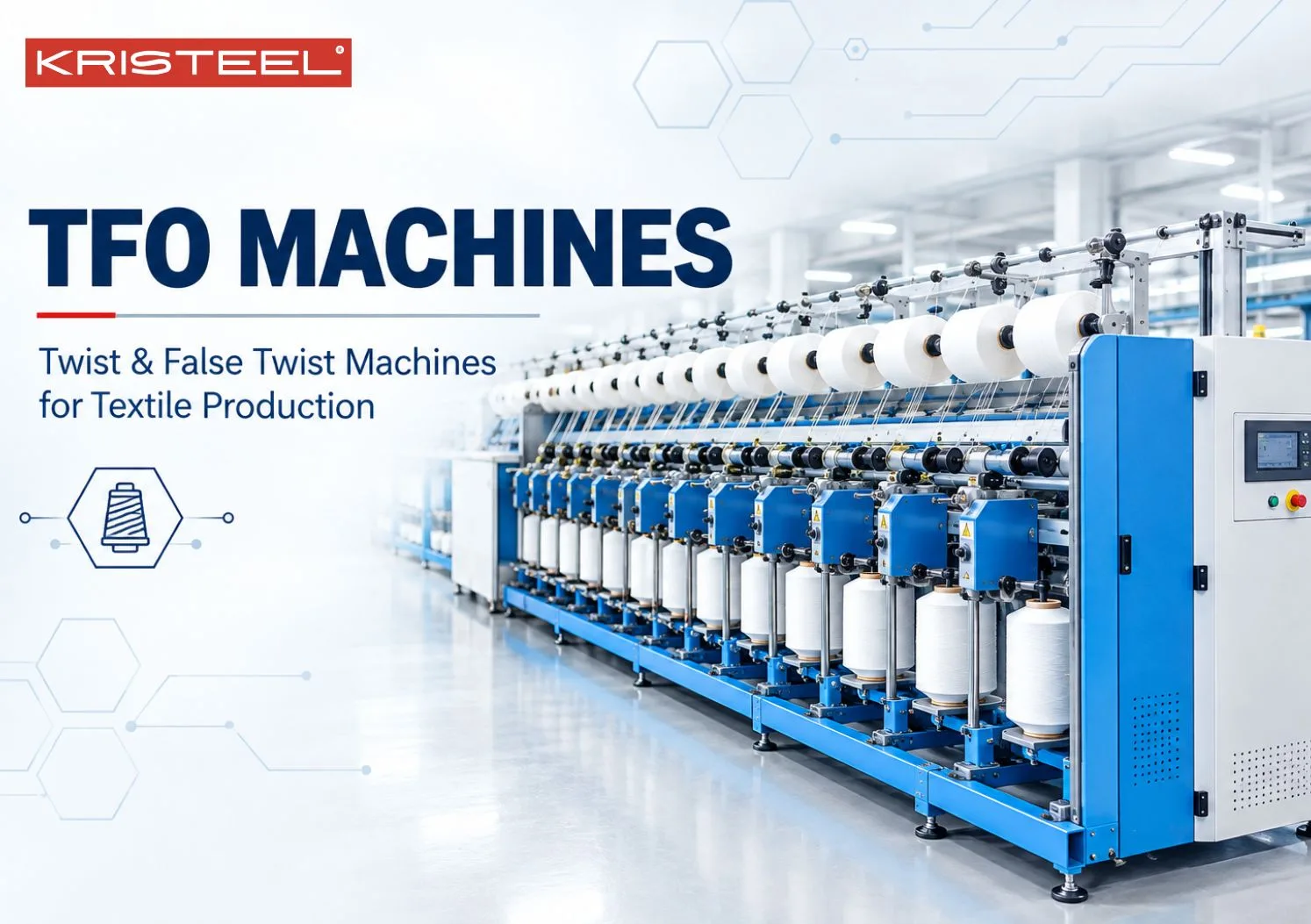
Selecting different types of TFO machines directly determines yarn strength and stability, making twisting as critical as the fibre itself. A TFO machine is a textile machine that uses two-for-one twisting technology, inserting two twists into the yarn with each spindle rotation rather than one. Different yarn specifications require specific machine setups, spindle speeds, tension settings, and twisting parameters to achieve consistent performance, quality, and production efficiency. In this blog, you will learn about the different types of TFO machines and how they can be configured to handle various yarn materials and counts.
What Is a TFO Machine?
TFO stands for Two-for-One, describing how the machine inserts twist: two twists per spindle rotation instead of the single twist conventional twisting methods deliver. That efficiency comes from the machine’s core components working together: yarn feeding and tension control, spindle and balloon control, and a take-up and winding system that collects the finished yarn onto its package. Twisting parameters set across these components- tension, speed, and twist level, directly determine the final yarn’s quality, which is why a Two for One Twisting Machine needs careful setup rather than a one-size-fits-all configuration.
How Does a Two-for-One Twisting Machine Work?
Yarn is supplied to the machine, then passes through the tension and guiding system that keeps the feed consistent. The twisting mechanism inserts twists as it moves through, after which the yarn passes through the balloon-control and delivery arrangement that manages yarn path and stability. Twisted yarn then winds onto the package, completing the cycle.
Types of TFO Machines
Exact classification varies between manufacturers, but a few broad configurations cover most of the market.
Single-Twist TFO Machines
These suit applications where controlled twisting is the main requirement rather than maximum throughput.
Double-Twist / Two-for-One Twisting Machines
Built for continuous yarn twisting at production scale, these machines handle sustained output where consistency across long runs matters most. Kristeel’s range, for instance, is available from 12 spindles up to 90 spindles depending on requirement, with more than 550 machines currently in operation.
TFO Machines for Synthetic Yarn
Polyester, nylon, polypropylene, and other synthetic yarns bring their own tension and heat-related considerations, since synthetic fibres respond differently to friction and speed than natural fibres do.
TFO Machines for Cotton and Natural Fibres
Natural-fibre yarns often need different tension, speed, and handling settings, given how differently these fibres behave under mechanical stress compared to synthetics.
TFO Machines for Blended Yarns
Machine flexibility matters considerably here, since blended yarns combine fibres that can behave differently during twisting within the same run.
How to Choose a TFO Machine for Different Yarn Types
Machine selection should follow the yarn’s actual characteristics, not a generic assumption about what “should” work.
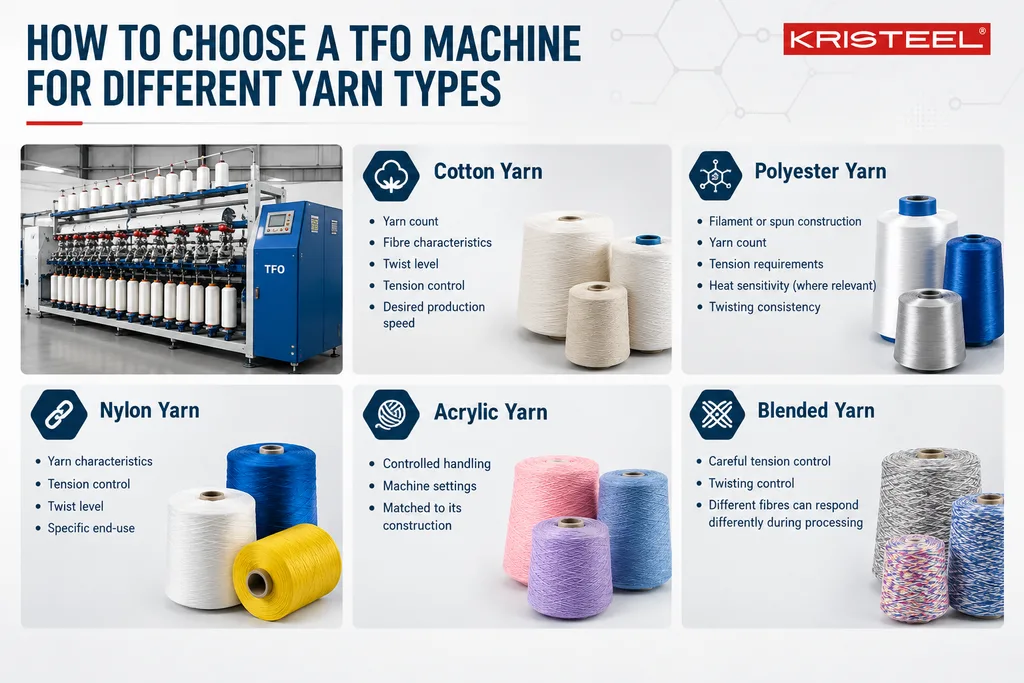
Cotton Yarn depends on yarn count, fibre characteristics, twist level, tension control, and desired production speed.
Polyester Yarn considerations include filament or spun construction, yarn count, tension requirements, heat sensitivity where relevant, and twisting consistency.
Nylon Yarn calls for attention to yarn characteristics, tension control, twist level, and the specific end-use.
Acrylic Yarn needs controlled handling and machine settings matched to its construction.
Blended Yarn often requires careful tension and twisting control, since different fibres in the same blend can respond differently during processing.
Key Factors to Consider When Selecting TFO Twisting Machines
Selecting the right TFO Twisting Machines requires evaluating several interdependent variables to ensure your facility can handle specific material processing demands efficiently.
- Yarn count and diameter influence whether the machine can accept the intended range at all.
- All natural, synthetic, filament, spun, or blended materials are strongly affected by fibre type in processing needs
- The twist level is given in twists per metre or turns per inch, and it affects the selection of machine and operating parameters
- The production capacity depends on the spindle speed, the number of spindles, and the machine type
- Kristeel range characteristics are formulated over denier ranges from 500D to 5000D to meet varied industrial yarn requirements
TFO Machine Parameters That Affect Yarn Quality
Spindle speed, twist level, yarn tension, delivery speed, balloon control, winding tension, package formation, and machine alignment all influence the finished yarn together. Incorrect settings in any of these areas can produce uneven twist, yarn breaks, inconsistent packages, or other quality issues that surface once the yarn is already in production.
Benefits of Using TFO Twisting Machines
Two-for-one twisting technology delivers exceptional yarn processing efficiency, providing consistent twist insertion across long, demanding textile manufacturing runs.
- Enhanced output accelerates twisting productivity to maximize daily textile volume.
- Streamlined handling lowers physical manual intervention steps throughout active yarn processing.
- Continuous operations sustain non-stop industrial production without costly machinery downtime.
- Uniform quality maintains a precise, reliable twist structure across every yarn batch.
What to Look for in a TFO Machine Manufacturer
While looking for a TFO Machine Manufacturer, first evaluate machine characteristics, supported yarn types and counts, and build quality. Automation and control systems, customisation possibilities, and installation and commissioning support all play a role in a seamless deployment. Operator training, availability of spare parts, and continuous maintenance support ensure the machine will continue to operate long after installation. Kristeel is one of the largest Industrial Yarn Twisting Machine manufacturers in India under the name of the “Krislon” Brand.
Common Applications of TFO Twisted Yarn
TFO-processed yarn delivers the necessary durability and structural uniformity required for various textile manufacturing sectors.
Target Applications
- Apparel textiles: Textiles used in the apparel sector give the body that is needed to make clothing.
- Home textiles: This is a positive for home textiles as it also improves the structural strength of home materials.
- Heavy-duty fabrics: Heavy-duty fabrics are developed to endure tough industrial uses.
- Upholstery: Upholstery is the covering of furniture and it gives an incredible amount of wear resistance.
Conclusion
There is more to choosing the proper TFO Machine than just looking at spindle speed or production capacity on a spec sheet. The decision should be based on all the following factors: yarn type, yarn count, fibre qualities, twist needs, tension control, package size, automation and production volume. Textile companies can guarantee constant twisting performance and efficient output by choosing suitable TFO twisting machines and working together with a technically sound TFO machine manufacturer.