Precision Stamped · ISO 9001 Certified · Made in India
Battery Terminal Connector Manufacturers in India
Kristeel manufactures precision stamped battery terminal connectors for electric vehicles, telecom infrastructure, solar energy storage, UPS systems, and industrial applications — with in-house plating and tape-and-reel packing capability.
Manufacturing Capability at a Glance
- Progressive die stamping from coil — high-volume, consistent quality
- Prototyping via photochemical etching — low MOQ, no hard tooling cost
- In-house tin plating and nickel silver coating
- Tape-and-reel packing for SMT and automated assembly lines
- Custom profiles accepted — supply your drawing or describe your requirement
- R&D support through to bulk production — single supplier relationship
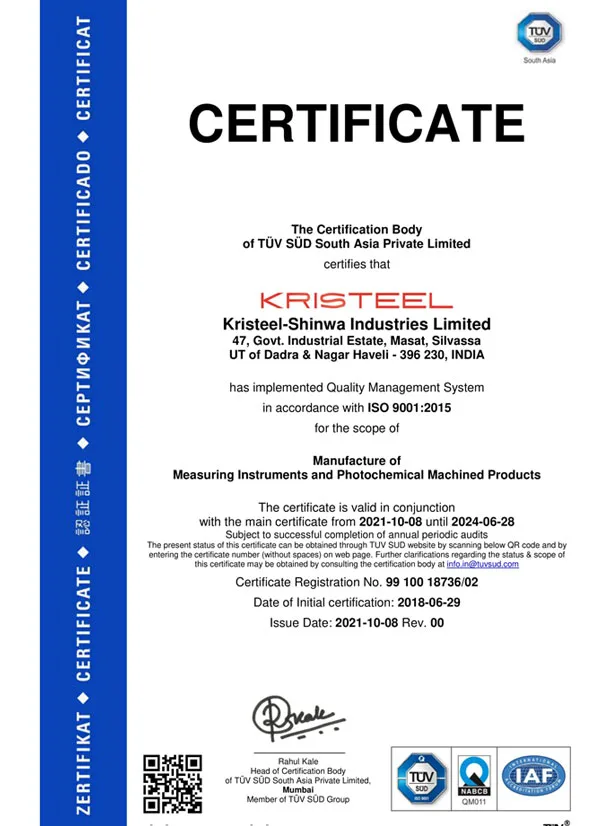
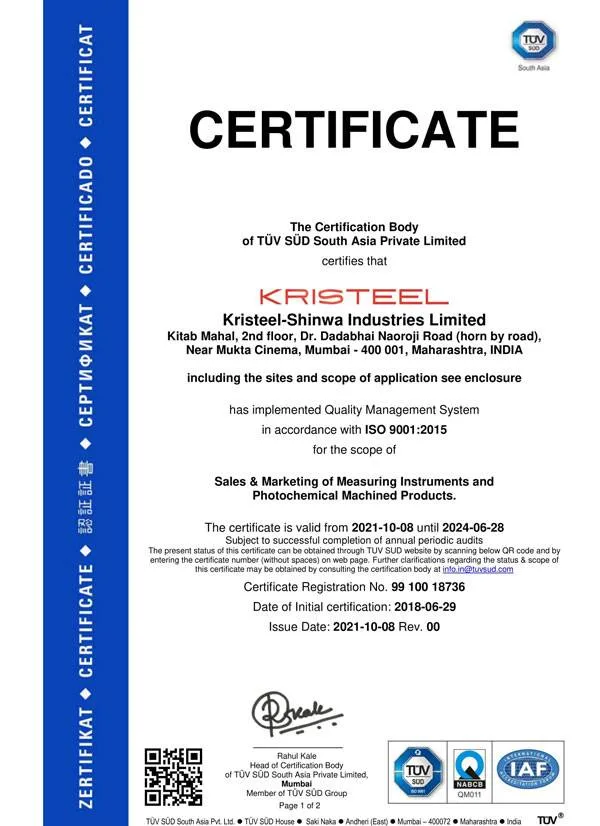
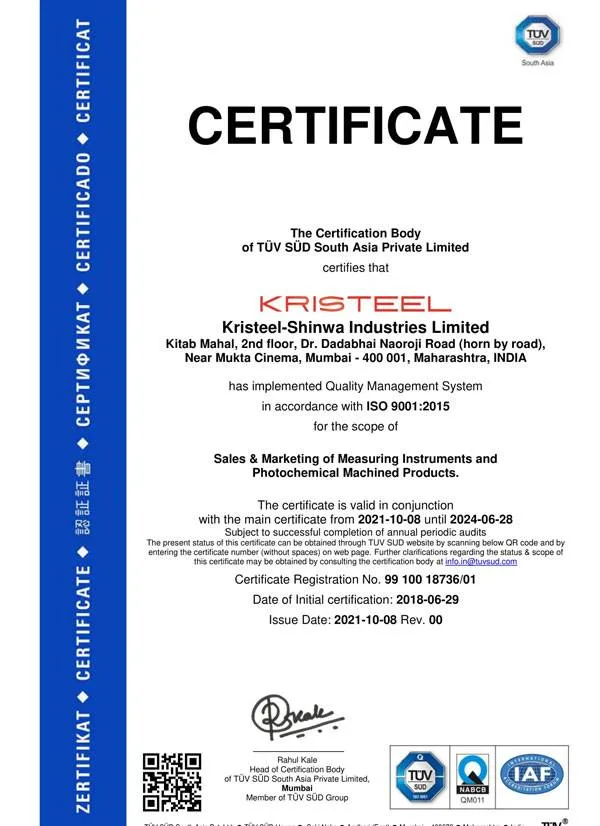
- ISO 9001:2015 certified · Silvassa & Bangalore factories
Schematic cross-section of a stamped battery terminal connector showing material body, surface plating, current path, and mounting geometry. Actual profiles are customised to your drawing.
Understanding the Product
What is a Battery Terminal Connector?
A battery terminal connector is a precision-formed metal component that creates a secure, low-resistance electrical connection between a battery cell or pack and the external circuit — whether that is a vehicle drivetrain, a telecom base station, a solar inverter, or an industrial control system.
Unlike commodity battery clips, precision stamped battery terminal connectors are engineered to exact dimensional tolerances, with controlled contact geometry, specific spring characteristics, defined plating thickness, and material grades selected for current-carrying capacity, corrosion resistance, and thermal performance.
At Kristeel, battery terminal connectors are produced using progressive die stamping on imported presses — the same manufacturing platform that underpins our RF shields, bipolar plates, and encoder disks. This means your connector is produced to the same quality discipline as components going into aerospace and defence assemblies.
Whether you need a simple flat tab terminal, a multi-cell interconnect bus, or a complex formed contact with integral spring function, Kristeel’s engineering team can work from your drawing or help develop the right design for your application.
Types of Battery Terminal Connectors
Which terminal type does your application need?
Automotive · Industrial
Electronics · BMS
EV · Energy Storage
Smart Meters · Consumer
Telecom · UPS
Industries Served
Where Kristeel Battery Terminals Are Used
Wherever reliable electrical connection to a battery is critical — from an electric vehicle drivetrain to a remote solar installation — precision matters. Kristeel supplies battery terminal connectors across these sectors.
Electric Vehicles (EV & HEV)
Cell-to-cell interconnect bus bars and pack-level terminals for lithium-ion and LiFePO4 battery packs. Must handle high current, vibration, and thermal cycling. Custom profiles matched to your pack geometry.
Automotive (ICE & 12V Systems)
Lead-acid battery terminal connectors for passenger cars, commercial vehicles, and two-wheelers. Tin-plated or brass construction for corrosion resistance in under-hood environments.
Telecom & Data Centres
Backup power terminals for VRLA and lithium battery banks in base stations, tower sites, and data centre UPS racks. Low-resistance connections that stay reliable across years of standby operation.
Solar Energy Storage (BESS)
Battery energy storage system interconnects for residential and utility-scale solar installations. Handles charge/discharge cycling, outdoor temperature ranges, and compliance with safety standards.
UPS & Industrial Power
Heavy-duty terminals and bus bars for industrial UPS systems, genset battery banks, and factory automation backup power. Reliable under infrequent but high-demand discharge events.
Smart Meters & IoT Devices
Spring contact battery terminals for AA, AAA, and coin-cell-powered metering and IoT hardware. Precision formed to maintain consistent contact pressure over the product’s service life.
Defence & Aerospace
High-reliability battery connections for military communications, UAVs, and avionics where material traceability, dimensional consistency, and performance under extreme conditions are non-negotiable.
Medical Devices
Battery holder contacts and terminals for portable medical equipment, monitoring devices, and emergency response equipment where connection reliability directly affects patient safety.
Materials & Grades
Choosing the Right Material for Your Battery Terminal
The material selection for a battery terminal connector determines its conductivity, contact resistance, corrosion behaviour, formability for complex profiles, and cost. Kristeel works with all standard industry materials and can advise on the optimum choice for your current rating, environment, and service life requirements.
| Material | Grade / Standard | Conductivity | Thickness Range | Key Properties | Best Application |
|---|---|---|---|---|---|
| Electrolytic Tough Pitch Copper (ETP) Highest Conductivity |
ASTM B152 / IS 191 C11000 |
100% IACS | 0.15 – 1.00 mm | Best-in-class electrical conductivity, excellent formability, good corrosion resistance. Industry standard for high-current bus bars and EV cell interconnects. | EV battery packs, BESS bus bars, high-current industrial terminals |
| Brass (Cu-Zn Alloy) Most Common |
IS 410 / ASTM B36 C26000, C27000, C28000 |
26–28% IACS | 0.20 – 1.50 mm | Excellent formability and spring characteristics, good corrosion resistance, cost-effective. Widely used across the industry for its balance of properties. | Automotive 12V terminals, spring contacts, blade terminals, smart meter contacts |
| Phosphor Bronze Best Spring Properties |
ASTM B103 / IS 7814 C51000, C52100 |
15–20% IACS | 0.10 – 0.80 mm | Exceptional spring properties and fatigue resistance. Retains contact force after millions of insertion cycles. Superior corrosion resistance versus brass. | Spring-loaded contacts, removable battery terminals, IoT devices, meters |
| Nickel Silver (Cupro-Nickel-Zinc) | ASTM B122 / NS-18 C75200, C77000 |
5–7% IACS | 0.15 – 0.60 mm | Natural bright finish, excellent corrosion and tarnish resistance. Kristeel has in-house NS processing capability for both RF shields and terminal connectors. | Smart meters, industrial electronics, applications requiring clean natural finish |
| Cold Rolled Steel (CRS) | IS 513 CR2/CR4 SPCC, SPCE |
17% IACS | 0.30 – 2.00 mm | High mechanical strength, low cost, excellent for structural battery brackets and heavy-duty clamp-style terminals. Requires plating for corrosion protection. | Battery clamps, heavy-duty industrial terminals, structural battery brackets |
| Stainless Steel | SS 304, SS 316 | 2–3% IACS | 0.20 – 1.00 mm | Outstanding corrosion resistance in aggressive environments. Lower conductivity means it is used for structural/mechanical roles rather than primary current-carrying paths. | Marine battery systems, outdoor enclosures, harsh chemical environments |
Current rating guidance and material selection support available from our engineering team. Send your requirement for a recommendation.
The Kristeel Advantage
Why engineers and procurement teams across India choose Kristeel
Since 1973, Kristeel has been supplying precision sheet metal components to demanding industries. Our battery terminal connector capability is built on the same manufacturing discipline that serves aerospace, defence, and electronics customers worldwide.
- ✓Prototyping via photochemical etching — receive functional samples from your drawing without investing in hard tooling. Ideal for design validation, R&D trials, and engineering approvals.
- ✓Progressive die stamping for production volumes — from a few thousand to millions of pieces per year, on imported high-speed presses with auto-feeders.
- ✓In-house tin plating and nickel silver coating — no external plating subcontractor. Tighter process control, faster turnaround, single-source accountability.
- ✓Tape-and-reel packing in EIA-481 standard carrier tape for direct feeder loading on automated assembly lines — eliminating manual handling and reducing line downtime.
- ✓DFM review included at no charge — our engineers check your drawing for formability, plating coverage, and dimensional feasibility before tooling begins.
- ✓R&D through bulk — one supplier, one relationship, one quality system across every stage of your product’s lifecycle.
- ✓ISO 9001:2015 certified with statistical process control at every manufacturing stage. Material certifications available on request.
Capability Specifications
Key parameters for battery terminal connector manufacturing.
Surface Finishing
In-House Plating for Battery Terminal Connectors
The plating on a battery terminal determines solderability, contact resistance stability, corrosion life, and compatibility with mating surfaces. Kristeel maintains in-house plating for two industry-standard finishes — giving you faster lead times and tighter quality control than an external plating vendor can offer.
Tin (Sn) Plating
Whisker growth risk in pure matte tin is managed through controlled plating thickness and process parameters in line with IPC/JEDEC standards.
Nickel Silver (NS) Coating
Other finishes including silver, ENIG, and selective plating combinations can be evaluated for specific requirements — contact our team.
Our Process
From Your Drawing to Your Production Line
Kristeel manages the complete manufacturing journey in-house — from DFM review and tooling through to plating and packing. No hand-offs to third parties at any critical stage.
Drawing & DFM Review
Customer drawing or spec reviewed for formability, plating coverage, minimum bend radii, and dimensional feasibility — before any tooling cost is committed.
Prototype via Etching
Functional samples produced via photochemical etching — no hard tooling required. Fast turnaround, low MOQ, suitable for R&D and engineering sign-off.
Tooling & Stamping
Progressive die tooling built for approved designs. High-speed stamping with auto-feeder delivers consistent dimensional accuracy across large production runs.
In-House Plating
Tin or nickel silver plating applied in our own facility. 100% batch traceability, controlled plating thickness, and quality checks at each stage.
Packing & Dispatch
Parts packed in bulk trays or tape-and-reel EIA-481 format. Inspection records, certificates of conformance, and material certs supplied as required.
Packing & Delivery
Delivered Ready for Your Assembly Process
Three packing configurations to match your production setup — from first engineering sample to automated high-volume assembly.
Engineering Samples
Small quantities in anti-static pouches or labelled trays for R&D, design validation, and customer approval. No production tooling required at this stage — samples produced via photochemical etching.
Bulk Tray Packing
Production quantities packed in thermoformed trays or custom waffle trays. Suited to manual assembly, wave solder, and semi-automated lines. Trays labelled with part number, batch, and quantity.
Tape & Reel (EIA-481)
Industry-standard carrier tape and reel format for direct pick-and-place machine loading. Eliminates manual singulation, supports lights-out SMT production, and reduces the risk of handling damage on small spring-contact terminals.
Common Questions
Frequently Asked Questions
Questions we regularly hear from engineers and procurement managers evaluating battery terminal connector suppliers.
Ready to discuss your battery terminal connector requirement?
Send us your drawing and we will review it, advise on material and plating, and respond with a quotation — typically within two business days. No tooling commitment required to receive a sample quotation.