Precision Bus Bars
for Power-Critical Applications
Kristeel manufactures custom copper and aluminium bus bars for EV battery packs, switchgear, solar inverters, data centre UPS systems, and industrial power distribution — with in-house plating and full DFM support from prototype to volume production.
What is a Bus Bar?
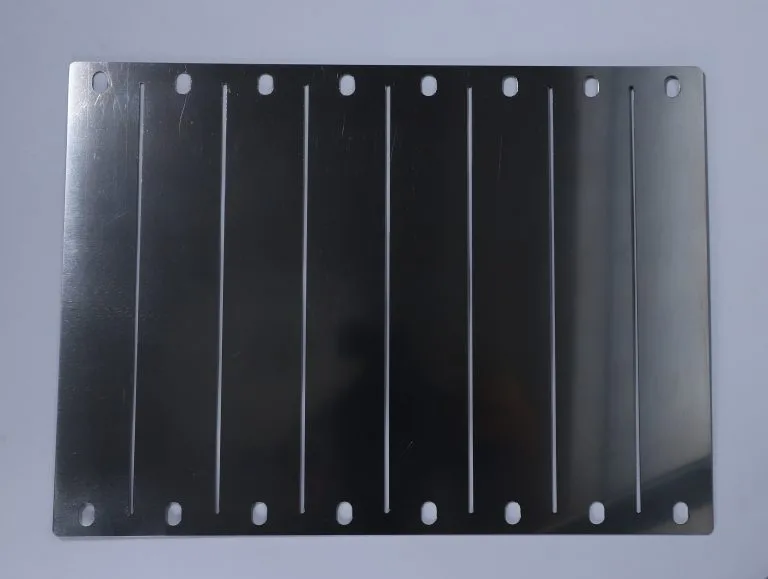
A bus bar (also written busbar or buss bar) is a solid metal conductor — typically a flat strip or bar of copper or aluminium — that collects electrical power from one or more sources and distributes it to multiple circuits, loads, or components within a system. Where traditional cable wiring creates a web of individual connections, a bus bar creates a single, organised, low-resistance distribution point.
Bus bars are specified wherever high current, low resistance, and reliable connection geometry matter simultaneously — in EV battery packs connecting lithium-ion cells, in switchgear and distribution boards feeding industrial loads, in solar inverters linking string combiners to the DC link, and in data centre UPS systems providing backup power to server racks.
Kristeel manufactures precision stamped bus bars using progressive die tooling and photochemical etching — the same manufacturing platforms that serve our RF shielding, battery terminal, and bipolar plate production. Every bus bar is produced to a customer drawing, with hole positions, bend profiles, width, thickness, and plating all specified to the application. We do not stock standard sizes — every part is custom.
In-house tin plating and nickel silver coating, combined with DFM review and photochemical etching for prototyping, means Kristeel can support a bus bar programme from initial R&D sample through to high-volume production without changing supplier.
Indicative Current Ratings by Profile
Current-carrying capacity depends on material, cross-sectional area, ambient temperature, and cooling conditions. These figures are indicative at 40°C ambient with natural convection. Kristeel can assist with current density calculations for your specific application.
The table below covers the most commonly specified copper and aluminium bus bar profiles. Custom widths and thicknesses are produced to any dimension within our press capability. Green values indicate approximate continuous current rating in Amperes under standard conditions.
| Width × Thickness | Cross-Section (mm²) | ETP Copper — Approx. Current (A) | Aluminium AA1350 — Approx. Current (A) | Typical Application |
|---|---|---|---|---|
| 10 × 3 mm | 30 mm² | ~180 A | ~120 A | Battery management, small switchgear, PCB busbars |
| 20 × 3 mm | 60 mm² | ~280 A | ~185 A | EV cell interconnects, small UPS, telecom battery banks |
| 25 × 4 mm | 100 mm² | ~390 A | ~260 A | Solar inverter DC link, distribution boards up to 400A |
| 40 × 4 mm | 160 mm² | ~520 A | ~345 A | EV battery pack interconnects, industrial UPS, motor drives |
| 50 × 5 mm | 250 mm² | ~700 A | ~465 A | Switchgear up to 800A, large solar BESS, industrial panels |
| 60 × 6 mm | 360 mm² | ~900 A | ~600 A | MV/LV switchgear, data centre PDUs, railway battery systems |
| 80 × 8 mm | 640 mm² | ~1350 A | ~900 A | High-current distribution, large EV packs, substation equipment |
| 100 × 10 mm | 1000 mm² | ~1800 A | ~1200 A | Main distribution panels, grid-scale storage, heavy industrial |
| * Ratings are indicative only at 40°C ambient, natural convection, horizontal installation. Actual ratings depend on installation geometry, thermal environment, and surface finish. Current density assumed at ~2.5 A/mm² for copper, ~1.65 A/mm² for aluminium. Kristeel does not guarantee electrical performance — contact your electrical engineer for rated system design. Custom profiles stamped to any dimension within press capacity. | ||||
Which Bus Bar Configuration Do You Need?
Bus bar geometry is driven by installation space, current path, connection points, and thermal requirements. Kristeel produces all common configurations to customer drawings.
Flat Bar / Strip Busbar
The simplest and most common form — a flat rectangular cross-section conductor with punched mounting and connection holes. Produced in copper or aluminium to any width and thickness within press capability.
Formed / Bent Busbar
Flat bar with one or more 90° or compound bends to follow the three-dimensional routing inside a panel or battery enclosure. Bends are formed in-house alongside blanking and hole piercing in a single operation.
Laminated / Stacked Busbar
Multiple thin copper laminations stacked between insulating layers — flexible, low-inductance connections for high-current applications where rigid bars cannot accommodate thermal expansion or vibration. Kristeel supplies the copper laminations.
Split / Multi-Section Busbar
A bus bar split into segments with connection joints — allowing sectionalisation, maintenance isolation, and easier assembly in large switchboards. Multiple pieces produced in the same material and plating specification.
U-Channel / Profiled Busbar
Formed to a U, L, or custom channel profile for structural rigidity at higher cross-sections, or for enclosing and guiding cables alongside the current-carrying conductor. Formed from flat blanks in Kristeel’s press tooling.
EV Cell Interconnect Busbar
Precision-formed busbars connecting battery cells in series or parallel within a lithium-ion battery pack. Must accommodate cell-to-cell dimensional variation, thermal cycling, and vibration while maintaining low-resistance electrical contact. Custom profile per pack design.
Where Kristeel Bus Bars Are Specified
Bus bars are infrastructure-level components — they sit at the heart of the power distribution architecture. Kristeel supplies across every major industry where that architecture needs to be reliable, compact, and custom.
Electric Vehicles
Cell-to-cell interconnect bus bars and pack-level HV busbars for BEV, HEV, and PHEV battery packs. Must handle high pulse currents, thermal cycling from −40°C to +80°C, and vibration per automotive standards. ETP copper with nickel or tin plating specified for cell contact faces.
Switchgear & Panels
Phase busbars, neutral bars, and earth continuity conductors for LV and MV switchgear, distribution boards, and motor control centres. Aluminium for cost-efficiency on long runs; copper where space is constrained or current density is high.
Solar & BESS
DC link busbars in string inverters and central inverters, battery energy storage system (BESS) interconnects, and combiner box busbars. Tin-plated copper for outdoor-rated inverter assemblies with corrosion resistance requirements.
Data Centres & Telecom
UPS battery bank busbars, PDU (power distribution unit) internal conductors, and busway section connectors for hyperscale data centres. Precision tolerances for bolt-together busway systems where contact resistance directly affects efficiency at megawatt scale.
Drives & Automation
DC link busbars in variable frequency drives (VFDs), servo amplifiers, and industrial power supplies. Capacitor bank connections in power factor correction equipment. Low-inductance formed profiles for high-frequency switching applications.
Railway Systems
Onboard battery busbars for diesel-electric multiple units, metro train auxiliary power systems, and trackside substation equipment. Must meet railway EMC and vibration standards with full material traceability.
Defence & Aerospace
High-reliability power distribution busbars for naval, ground, and airborne platforms. Material certifications, full batch traceability, and dimensional inspection records supplied with each order.
Choosing the Right Bus Bar Material
Material selection for a bus bar is primarily a function of conductivity requirement, weight constraint, environmental conditions, and budget. Kristeel works with all standard bus bar materials and can advise on grade, temper, and plating combination for your application.
| Material | Grade / Standard | Conductivity | Density | Key Properties | Best Application |
|---|---|---|---|---|---|
| ETP Copper Best Conductivity |
ASTM B187 / IS 613 C11000 |
100% IACS 58 MS/m |
8.9 g/cm³ | Industry benchmark for bus bar conductivity. Excellent formability, solderable, available in half-hard and hard tempers. Higher cost but smaller cross-section for same current rating vs aluminium. | EV packs, switchgear, UPS, solar inverters — wherever space is at a premium |
| Aluminium (Electrical Grade) Best Weight/Cost |
AA 1350-H12/H14 AA 6101-T6 |
60–61% IACS 34–35 MS/m |
2.7 g/cm³ | One-third the weight of copper. 60% the conductivity — compensated by larger cross-section. Significant cost advantage on large busbars. AA6101 offers better mechanical strength than AA1350. | Distribution boards, switchgear long runs, data centre busways, cost-sensitive large-panel applications |
| Brass (Cu-Zn Alloy) | IS 410 / ASTM B16 C36000, C37700 |
26–28% IACS | 8.5 g/cm³ | Good formability and machinability. Lower conductivity than copper limits use to lower-current applications. Cost-effective for connection lugs, terminal blocks, and short distribution segments. | Terminal bus bars, neutral bars in domestic distribution, connection hardware |
| Nickel Silver (NS) | NS-18 ASTM B122 |
5–7% IACS | 8.7 g/cm³ | Good corrosion and oxidation resistance. Lower conductivity restricts to signal and low-current distribution busbars. Kristeel has in-house NS processing capability. | Instrumentation bus bars, low-current control panels, corrosion-critical environments |
| Copper-Clad Aluminium (CCA) | Custom composite | ~70–80% IACS effective | ~4.0 g/cm³ | Aluminium core with copper cladding — combines the weight advantage of aluminium with copper’s superior surface conductivity and solderability. Emerging in EV applications for weight saving. | EV bus bars where weight saving is critical, premium distribution applications |
Temper selection (half-hard, hard, full-hard) affects formability for bends — contact our team to discuss the right temper for your profile and bend radius requirements.
Why engineers and procurement teams choose Kristeel for bus bars
Five decades of precision stamping and photochemical etching experience means Kristeel has manufactured bus bars for demanding applications across EV, defence, industrial, and power infrastructure sectors. We understand the engineering requirements — not just the metalworking.
- Prototyping via photochemical etching — functional bus bar samples from your DXF or STEP file with no hard tooling investment. Receive samples for R&D, design validation, and fitment checks within days.
- Progressive die stamping for production volumes — blanking, hole piercing, and forming in a single die progression on imported high-speed auto-feed presses.
- In-house tin plating and nickel silver coating — single-source accountability from bare metal to plated finished part. No external plating vendor delays.
- DFM review at no charge — bend radius feasibility, minimum land between holes, plating coverage into countersink faces, and dimensional tolerance review before any tooling cost is committed.
- Tape-and-reel packing capability for smaller bus bar profiles destined for automated SMT or robotic assembly lines.
- Material certificates and certificates of conformance supplied with every production shipment. Full batch traceability maintained.
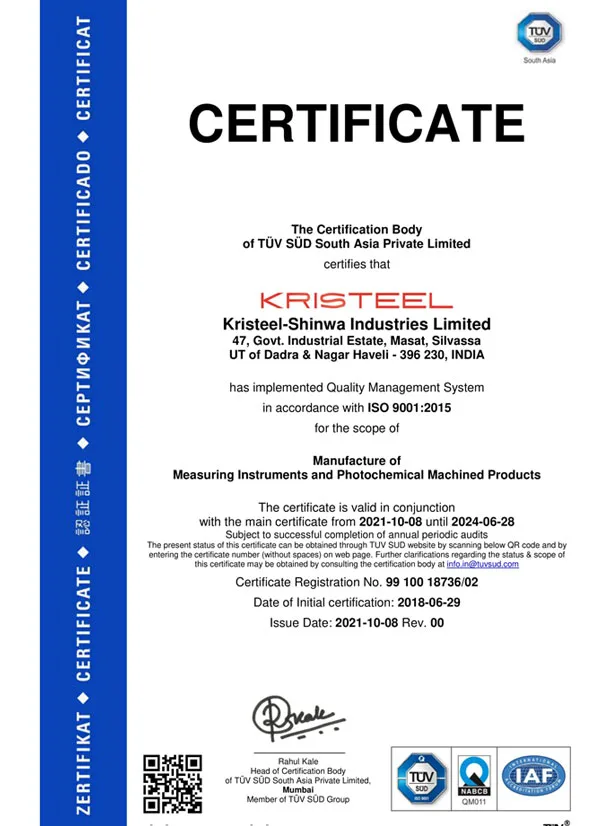
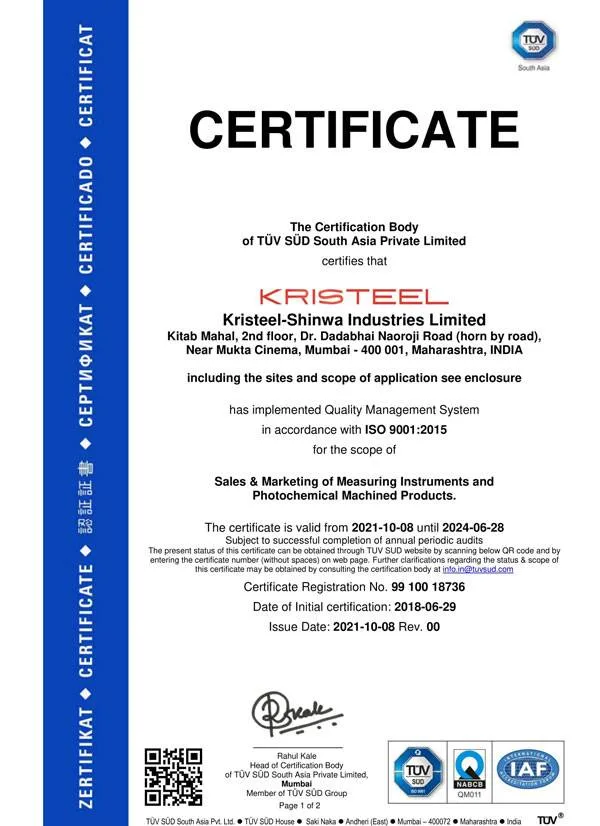
- ISO 9001:2015 certified manufacturing facilities in Silvassa and Bangalore with SPC at every critical stage.
Capability Specifications
Plating Options for Bus Bars
Plating on a bus bar serves three functions: corrosion protection of the substrate, maintenance of low contact resistance at bolted joints over service life, and in some applications, solderability. Kristeel offers in-house plating for the two most widely specified finishes, with guidance on additional options.
Tin (Sn) Plating
Matte tin is the most widely specified bus bar plating — good corrosion protection, excellent solderability, and stable contact resistance over the service life of the installation.
Applied over a nickel underplate for improved adhesion, barrier layer against copper diffusion, and extended corrosion life in demanding environments.
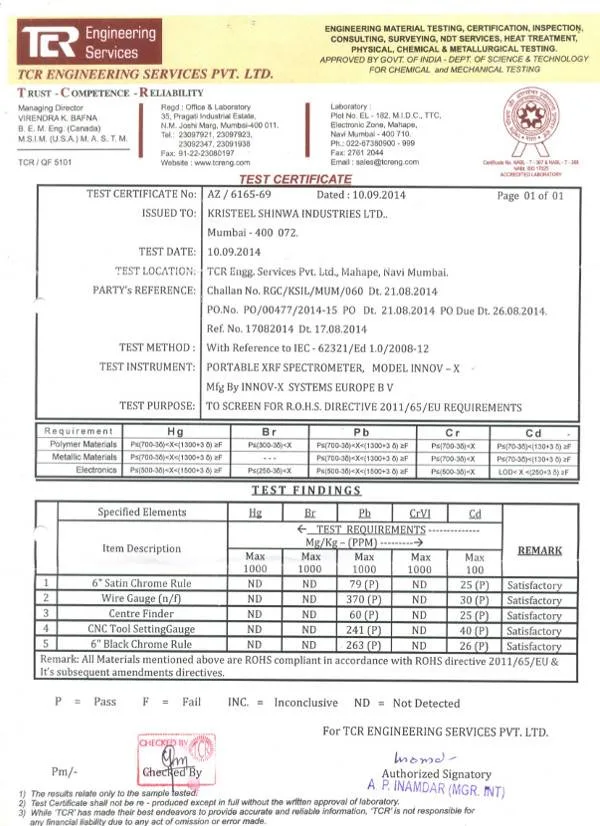
RoHS-compliant. Industry-standard specification for copper bus bars in switchgear, EV, and solar applications.
Kristeel applies tin plating in-house — not subcontracted — giving tighter control over plating thickness (typically 5–15 μm on bus bars) and coverage into countersink and edge profiles.
Nickel Silver (NS)
Cu-Ni-Zn alloy with a bright silver-white appearance — used both as a substrate and as a surface treatment for bus bars requiring corrosion resistance without additional plating cost.
Good oxidation and tarnish resistance for bus bars in enclosed panels and low-humidity environments where tin plating would also be specified.
Kristeel has established in-house NS processing — the same facility serving RF shield and battery terminal production — with consistent batch-to-batch quality control.
Can be combined with selective tin plating on contact faces where bolted-joint contact resistance must be minimised.
Silver (Ag) & Nickel (Ni)
Silver plating provides the lowest contact resistance of any common bus bar finish and is specified for high-current switchgear (above 1000A) and railway applications where joint resistance is critical. Kristeel can co-ordinate silver plating via established external partners.
Nickel plating (electroless or electrolytic) provides hard, wear-resistant surfaces with excellent corrosion resistance at elevated temperatures. Preferred for defence and aerospace bus bars and for copper bus bars in high-voltage switchgear where tin dendrite risk must be eliminated.
Contact Kristeel to discuss silver or nickel plating requirements — we will advise on specification, thickness, and source.
From Drawing to Finished Bus Bar
Every bus bar Kristeel manufactures is produced to a customer drawing. No standard catalogue sizes. Every dimension, hole position, bend profile, and plating spec is confirmed before production begins.
DFM Review
Drawing reviewed for minimum hole-to-edge distance, bend radius feasibility per material temper, plating coverage into countersinks, and dimensional tolerances achievable within press and tooling capability. No-charge review before any tooling cost is committed.
Prototyping (PCM)
First samples produced via photochemical etching — no hard tooling, low MOQ, fast turnaround. Allows fitment verification, current testing, and design iteration before progressive die tooling is ordered.
Tooling & Stamping
Progressive die tooling designed and built in-house. Production run on imported high-speed presses with auto-feeder — blanking, piercing, and forming completed in a single pass through the die.
In-House Plating
Tin or nickel silver plating applied in Kristeel’s own plating facility. Plating thickness checked dimensionally. Adhesion and coverage into hole walls and edges verified per batch. No external plating vendor in the supply chain.
Inspection & COC
Dimensional inspection against drawing. Plating thickness spot-check. Visual inspection for burrs, edge condition, and surface defects. Certificate of conformance and material test certificate issued with every production shipment.
Frequently Asked Questions
Questions asked most often by electrical engineers, EV design teams, and procurement managers evaluating bus bar suppliers in India.
Send your bus bar drawing.We’ll review and respondwithin 48 hours.
DFM review is included at no charge. Supply a drawing, DXF, STEP file, or describe your requirement and our engineers will advise on material, plating, and profile — then quote for both prototype and production quantities.