Metal Speaker Grills · PCM & Stamped · ISO 9001
Precision Metal Speaker Grill & Mesh Manufacturers in India
Kristeel manufactures precision perforated metal speaker grills and acoustic mesh for automotive audio, consumer electronics, professional sound systems, and smart devices — using photochemical etching for burr-free, acoustically accurate aperture patterns.
Understanding the Product
What is a Metal Speaker Grill?
A metal speaker grill — also called an acoustic mesh, speaker guard, or speaker grille — is a precision-perforated sheet metal component that sits in front of a loudspeaker driver. It serves two roles simultaneously: protecting the driver cone from physical contact and contamination, while allowing sound waves to pass through with minimal acoustic attenuation.
What distinguishes a precision-manufactured metal speaker grill from a commodity perforated sheet is the discipline applied to every variable that affects both acoustic performance and visual quality — aperture shape, aperture diameter, open-area ratio, hole pitch, sheet thickness, material grade, edge treatment, and surface finish. A grill that looks similar to a cheaper alternative can perform very differently in acoustic tests and in service life.
Kristeel manufactures metal speaker grills using photochemical etching (PCM) — the same precision process used for our RF shields, encoder disks, and bipolar plates. PCM produces apertures that are geometrically perfect, stress-free, and burr-free on both faces. This is critical: a burr on the rear face of a speaker grill can vibrate sympathetically at certain frequencies, adding resonant artefacts to the reproduced sound.
For higher-volume production, speaker grills can also be produced using progressive die stamping and perforating tools, offering a lower per-piece cost at scale. Kristeel maintains both capabilities and can advise on the right process for your volume and tolerance requirements.
All patterns available in custom pitch and aperture diameter. Kristeel also produces non-repeating, logo-integrated, and decorative perforation patterns via PCM.
Manufacturing Process
Why Photochemical Machining is the Right Process for Speaker Grills
The aperture quality of a speaker grill directly affects acoustic performance and visual finish. PCM achieves what stamping and laser cutting cannot — and Kristeel has operated PCM production lines for over five decades.
Burr-free on both faces. The chemical etching process removes material uniformly — no mechanical force means no burr, no edge deformation, and no work-hardening around each aperture. Critical for grills where rear-face burrs could cause resonance.
Aperture tolerance of ±0.025 mm — consistent across every hole in the pattern, regardless of how many thousands of apertures are on the sheet. Stamped perforations vary slightly in size and shape hole-to-hole.
No tooling cost for design changes. The photomask (phototool) is modified digitally — aperture size, shape, pitch, pattern boundary, and logo integration can all change without retooling. Essential for product development iterations.
No stress induced in the parent material. The metallurgical properties of the sheet — hardness, temper, spring characteristics — are completely unchanged after etching. This matters for grills that will be subsequently formed.
Logo and decorative patterns are native. A brand logo, gradient perforation density, or custom geometric pattern is as easy to produce as a standard round-hole array. No additional process steps.
Lower per-piece cost at volume. Once a perforating die is built, stamped speaker grills are fast and economical for high-volume, standardised designs — typically above 50,000 pieces per annum.
Consistent output. Progressive die stamping on auto-feed presses delivers identical parts at high speed, well-suited to automotive speaker grill programmes with stable, locked-down specifications.
Forming and bending in the same die. A speaker grill that requires a deep-drawn flange, curved face, or attachment clip can be produced complete in a progressive tool — blank, perforate, form, and pierce in a single die progression.
Kristeel recommendation: Use PCM for prototyping, early production, and design-variant models. Transition to stamping for your highest-volume standard model once the design is locked. Kristeel supports both transitions from the same source.
Aperture Design
Standard and Custom Aperture Patterns
Aperture shape, diameter, pitch, and open-area ratio together determine the acoustic transparency, structural strength, and visual character of a speaker grill. Kristeel produces all standard patterns and can develop custom perforation designs to your specification.
Round Holes — Square Pitch
Most widely used. Balanced open area, isotropic strength, clean industrial look. Standard for most consumer and automotive grills.
Open area: 55–65% typical
Round Holes — 60° Staggered
Offset rows give higher open area than square pitch for the same hole size. Premium audio choice — preferred for high-end speaker grills.
Open area: 65–75% typical
Elongated Slots
Directional aperture providing high open area with maintained rigidity in the perpendicular direction. Common in automotive door panels and tweeters.
Open area: 55–70% typical
Hexagonal Honeycomb
Maximum open area from any pattern type. Visually distinctive — associated with premium and professional audio brands. Excellent strength-to-openness ratio.
Open area: 75–82% typical
Custom aperture sizes, pitches, gradient perforation density (denser at edges, more open at centre), logo integration, and mixed-pattern designs are all available via PCM — share your design brief and we will advise on feasibility.
Industries Served
Where Kristeel Metal Speaker Grills Are Used
Metal speaker grills are specified wherever a fabric or plastic grill is inadequate — in demanding acoustic, aesthetic, or environmental conditions across these industries.
Automotive Audio
Door speaker grills, dashboard tweeter grills, and subwoofer covers for passenger cars, SUVs, and commercial vehicles. Must withstand UV, temperature cycling, humidity, and vibration in automotive environments. Custom-formed to follow door panel curves.
Consumer Electronics
Soundbar grills, Bluetooth speaker mesh panels, smart display speaker covers, home theatre systems, and portable audio devices. Precision perforated stainless or aluminium for a premium product feel.
Professional Audio
Studio monitor grills, PA speaker covers, and line array end caps for live sound systems. High open-area ratios to minimise acoustic colouration. Heavy-gauge construction for road and stage durability.
Smart Home & IoT Devices
Smart speaker mesh (voice assistants, smart displays), intercom panels, and home security device speaker openings. Micro-aperture patterns for clean, unobtrusive aesthetic on visible consumer devices.
Telecommunications
Handset speaker grills, conference phone mesh panels, VoIP desk phone speaker covers, and public announcement system grills in transit and public infrastructure.
Defence & Industrial PA
Rugged speaker grills for military field communications, industrial public address systems, and hazardous environment intercom installations. Heavy-gauge stainless steel with high corrosion resistance.
Medical Equipment
Speaker covers for patient monitoring systems, anaesthesia workstations, and nurse call systems — where easy sterilisation, biocompatibility, and durability under clinical cleaning protocols are required.
Architectural & Installation Audio
In-ceiling and in-wall speaker grills, garden and outdoor speaker covers, and stadium PA system grills. Custom shapes, RAL colour matching, and weather-resistant finishes available.
Materials & Grades
Material Selection for Metal Speaker Grills
Material choice for a speaker grill balances acoustic transparency (higher open area is easier in some materials), formability for curved profiles, corrosion resistance for the end environment, and visual finish. Kristeel processes all standard materials for speaker grill applications.
| Material | Grade | Thickness Range | Minimum Aperture (PCM) | Key Properties | Typical Application |
|---|---|---|---|---|---|
| Cold Rolled Steel (CRS) Most Common |
IS 513 CR2/CR4 SPCC |
0.25 – 1.00 mm | ≈ thickness of material | Cost-effective, good formability, excellent for curved grills. Requires plating for corrosion protection. Ideal when painted or powder-coated finish is specified. | Automotive door speakers, consumer electronics, budget home audio |
| Stainless Steel (SS) Premium Finish |
SS 304, SS 316 BA / 2B finish |
0.15 – 0.80 mm | ≈ 0.8–1× thickness | Natural corrosion resistance — no plating needed. Bright BA finish or brushed 2B finish for premium product aesthetics. Harder to form than CRS but excellent final look. | High-end consumer audio, smart speakers, medical, outdoor & marine |
| Aluminium Lightweight |
AA 3003, AA 5052 H14, H32 temper |
0.30 – 1.50 mm | ≈ 1× thickness | Lightest material option. Good corrosion resistance. Anodising gives a wide range of colour options and a hard, premium surface. Cannot be spot-welded. | Portable audio, architectural speakers, weight-sensitive automotive applications |
| Brass | CuZn30, CuZn37 C26000, C27200 |
0.15 – 0.60 mm | ≈ thickness of material | Warm gold appearance without plating. Excellent formability and PCM etch quality. Premium decorative look for high-end hi-fi and vintage-aesthetic audio products. | High-end hi-fi speakers, heritage audio, decorative architectural grills |
| Nickel Silver (NS) | NS-18 C75200 |
0.15 – 0.50 mm | ≈ thickness of material | Silver-white appearance, excellent tarnish resistance. Kristeel has in-house NS processing. Premium alternative to silver-plated CRS for visible consumer audio. | Smart home devices, premium consumer electronics, branded audio products |
Open-area ratio, aperture size, and pitch can be optimised for acoustic transparency vs. structural requirements — contact our team with your driver size and frequency range for a recommendation.
The Kristeel Advantage
Why audio OEMs and electronics manufacturers choose Kristeel
Fifty years of precision photochemical machining and progressive die stamping experience means Kristeel has solved virtually every speaker grill manufacturing challenge before yours. Our engineers understand the relationship between aperture geometry, open area, and acoustic performance — not just the metalworking.
- Prototyping via PCM with no hard tooling — receive production-representative samples from your artwork file within days. Test acoustic performance and visual finish before any tooling commitment.
- Custom aperture patterns including logo integration, gradient density, and decorative designs — unique to your brand and not possible with standard perforated sheet.
- In-house tin plating and nickel silver coating alongside PCM production — no external plating vendor in the supply chain.
- Forming capability to produce curved, flanged, and deep-drawn grill profiles in the same facility as the perforating operation.
- Transition pathway from PCM (prototyping) to progressive die stamping (high-volume production) — single supplier relationship at every stage.
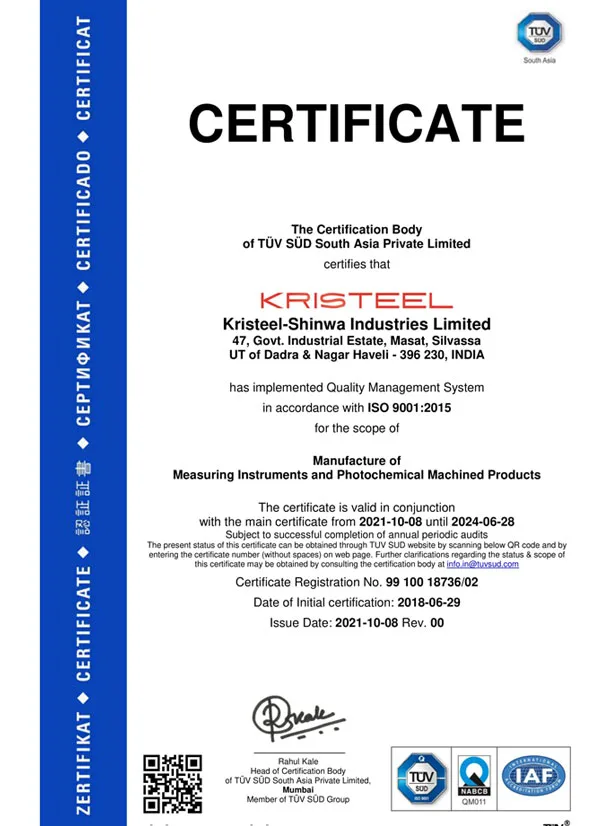
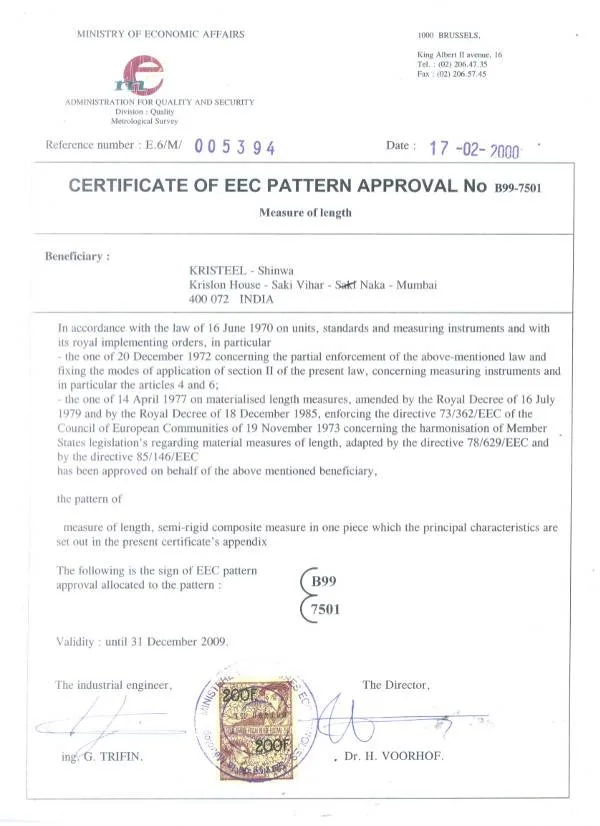
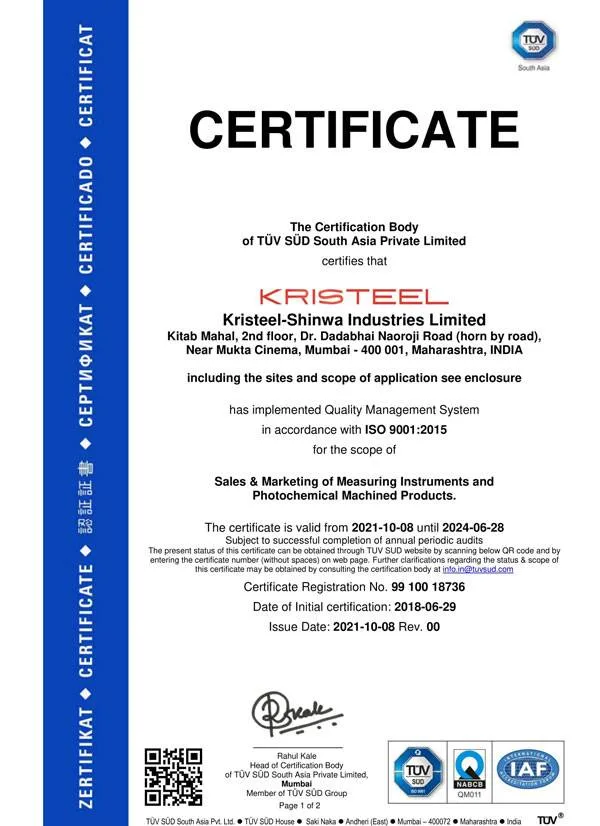
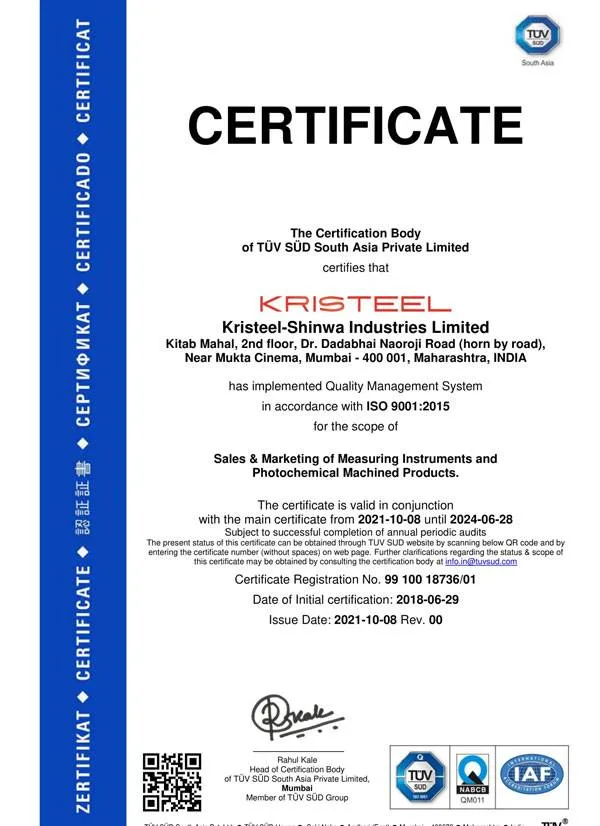
- ISO 9001:2015 certified with full batch traceability. Material test certificates available on request.
- Technical collaboration with M/s. Metal Etching Technology Associates Inc., USA — bringing US PCM process knowledge to Indian manufacturing.
Capability Specifications
Surface Finishing
Plating & Surface Finish Options
The surface finish of a speaker grill determines its corrosion life, visual quality, and compatibility with the product’s aesthetic language. Kristeel offers in-house plating alongside a range of finishes suited to metal speaker grills.
In-House: Tin (Sn) Plating
Matte tin over CRS substrate — the standard specification for speaker grills that will be subsequently painted or powder-coated, providing a corrosion-resistant base.
Bright tin for grills where the metallic finish is the final surface — silver-white appearance with good tarnish resistance in indoor environments.
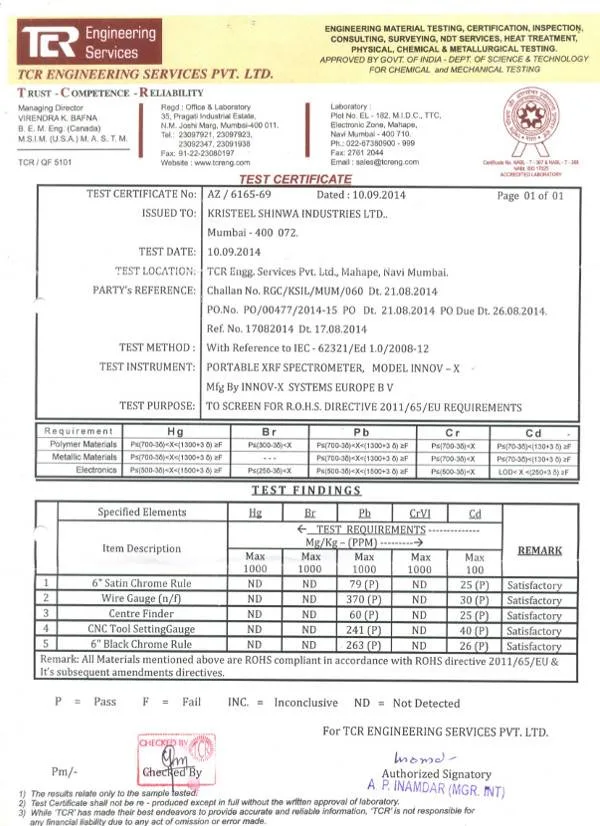
RoHS-compliant. Applied with controlled thickness for consistent coverage into aperture walls, not just on the flat faces.
Combined with nickel underplate for improved adhesion and extended corrosion protection in automotive and outdoor environments.
Tin plating is applied in Kristeel’s own facility — not subcontracted — giving tighter control over plating thickness and uniformity across the perforated area.
In-House: Nickel Silver (NS)
Copper-nickel-zinc alloy with a bright silver-white appearance — used both as a substrate material and as a surface treatment on CRS-based grills.
Natural tarnish resistance without additional lacquering — well suited to consumer audio products where the metallic finish is the intended aesthetic.
Kristeel has established in-house NS processing capability, shared with our RF shield production line — consistent batch-to-batch quality and fast turnaround.
Premium alternative to chrome plating for speaker grills requiring a bright, durable metallic appearance without environmental concerns around hexavalent chrome.
Other finishes including powder coat, anodising (on aluminium), black oxide, and selective painting can be advised on for your specific application.
Our Process
From Artwork to Finished Grill
Kristeel manages every stage of speaker grill production in-house — design review, phototool production, etching, forming, plating, and packing. No critical process step leaves our facility.
Artwork & DFM Review
Customer artwork or drawing reviewed for aperture feasibility, open-area ratio, minimum land width between holes, and forming requirements. We advise before any tooling or phototool cost is committed.
Phototool Production
High-resolution photomask produced from your approved artwork. For PCM, this is the only tooling cost — typically a fraction of hard die tooling. Changes are digital; no retooling fee for design revisions.
Photochemical Etching
Sheet is coated in photoresist, exposed through the phototool, developed, and chemically etched. Both faces etched simultaneously — burr-free apertures with uniform geometry across the full sheet.
Forming & Finishing
Flat etched blanks formed to curved, flanged, or three-dimensional profiles as required. In-house plating (tin or nickel silver) applied. Additional finishing — powder coat, painting — co-ordinated as specified.
Inspection & Dispatch
100% visual inspection against approved sample. Aperture dimensions checked to drawing. Parts packed to protect the perforated face. Certificates of conformance supplied with every shipment.
Common Questions
Frequently Asked Questions
Questions asked most often by audio OEMs, industrial designers, and electronics procurement teams evaluating metal speaker grill suppliers.
Start with a prototype. Scale with confidence.
Send us your artwork, drawing, or product brief. Our engineers will review the aperture pattern, advise on material and finish, and provide a quotation for both prototype and production quantities — usually within two business days.