Tab Terminal Manufacturers in India · Since 1973
Precision Stamped
Tab Terminals
& Blade Connectors
Kristeel manufactures precision stamped tab terminals, blade connectors, and quick-connect terminals for automotive wiring harnesses, white goods, industrial controls, and electronics — in standard series widths and fully custom profiles.
Request a SampleDownload Brochure →
2.8mm Series4.8mm Series6.3mm Series9.5mm SeriesCustom WidthTape & ReelISO 9001
4.8
Tab width (mm)
0.5
Tab thickness (mm)
15A
Typical current
Understanding the Product
What is a Tab Terminal?
A tab terminal — also called a blade terminal, quick-connect terminal, or FASTON-style connector — is a precision-stamped metal connector designed for fast, reliable, tool-free electrical connection. The male tab (a flat, rectangular blade) pushes into a matching female receptacle where spring-formed contact fingers grip the tab, creating a secure electrical joint with defined contact force and low, stable resistance.
Tab terminals are ubiquitous in electrical assembly because they are fast to connect and disconnect without tools, they can be pre-crimped to wires on automated equipment before final assembly, and they provide repeatable connection quality far superior to screw terminals in high-volume production.
The industry operates on standardised tab widths — 2.8mm, 4.8mm, 6.3mm, and 9.5mm — that define the width of the male blade. Each series has associated current ratings, wire gauge ranges, and mating receptacle geometry. Kristeel manufactures all four standard series as well as fully custom tab profiles to customer drawings.
Production uses progressive die stamping on high-speed auto-feed presses, with photochemical etching for prototype and low-volume custom work. In-house tin plating ensures consistent contact surface quality and RoHS compliance without external plating vendor delays.
Technical Reference
Standard Tab Terminal Series
Tab terminals are specified by blade width — the four standard series cover the overwhelming majority of electrical connection applications from automotive relays to industrial contactors. Kristeel manufactures all four series and custom widths outside this range.
Current ratings shown are typical maximum at ambient temperature with appropriate wire gauge. Always consult your system engineer for rated circuit design. Kristeel supplies terminals only — mating receptacles are not supplied unless specified.
| Series (Width) | Tab Thickness | Typical Max. Current | Wire Gauge Range | Connector Housing | Typical Applications |
|---|---|---|---|---|---|
| 2.8 mm | 0.5 mm | ≤ 6A | 0.5 – 1.5 mm² (20–16 AWG) |
Micro connector housings, compact relay bases, PCB-mounted | Automotive relays, motorcycle harness, small appliance controls, lighting |
| 4.8 mm | 0.5 – 0.8 mm | ≤ 15A | 0.75 – 4.0 mm² (18–12 AWG) |
Standard automotive connector housings (AMP, Molex, Delphi compatible) | Automotive main harness, white goods (washing machines, ACs), power tools |
| 6.3 mm | 0.8 – 1.0 mm | ≤ 25A | 1.5 – 6.0 mm² (16–10 AWG) |
Standard industrial and appliance housings | Industrial controls, heating elements, circuit breaker panels, HVAC equipment |
| 9.5 mm | 1.0 – 1.2 mm | ≤ 50A | 4.0 – 16.0 mm² (12–6 AWG) |
Heavy-duty housings, lugged versions for bolt-on use | High-current automotive (starter systems, alternator), industrial drives, UPS |
| Custom width | Per drawing | Per design | Per design | Customer-specified or proprietary housing | Defence, aerospace, medical, railway, and any application requiring non-standard geometry |
| * Current ratings are indicative only. Actual rating depends on wire gauge, housing material, ambient temperature, and number of loaded positions. Kristeel manufactures the metal terminal — rated assembly current must be determined by the system designer. Tab dimensions comply with IEC 60512-1 / DIN 46244 where applicable. | |||||
Terminal Configurations
Tab Terminal Types — Which Do You Need?
Beyond the standard male tab, the tab terminal family includes multiple configurations for different installation orientations, connection methods, and space constraints. Kristeel produces all types to customer drawings.
Also: Blade terminal, FASTON tab
Male Tab Terminal
The standard form — a flat rectangular blade crimped to a wire that pushes into a mating female receptacle. Available in all four standard series widths and custom profiles. The most common electrical quick-connect component worldwide.
Automotive · Appliances · Industrial
Also: Receptacle terminal, female blade
Female Receptacle Terminal
The mating counterpart to a male tab — a spring-formed metal housing with internal contact fingers that grip the inserted tab. Contact force and insertion/extraction force depend on spring material temper and geometry. Kristeel produces receptacle bodies to drawing.
All industries — mating pair to male tab
Also: PCB tab, vertical mount terminal
Right-Angle PCB Tab
A tab terminal with a 90° bend between the wire crimp barrel (horizontal) and the tab (vertical), or with a straight-pin tail for through-hole PCB mounting. Allows panel-mount connectors to connect directly to PCB without a separate flying lead.
Electronics · PCB assemblies · Controls
Also: Angled tab, 90° tab terminal
Flag / Angled Tab Terminal
The tab exits at 90° to the wire barrel — useful where the mating connector must approach from a perpendicular direction due to enclosure geometry or harness routing constraints. Common in automotive and appliance applications with complex three-dimensional wiring layouts.
Automotive · Appliances · Tight-space routing
Also: Stacking terminal, double blade
Double / Stacking Tab Terminal
A single crimp barrel with two tabs stacked vertically — allows two receptacles to connect from one terminal without a separate Y-junction. Eliminates an additional join point in the circuit, reducing resistance and assembly steps. Used in automotive fuse and relay boxes.
Automotive · Fuse boxes · Relay panels
Also: Board-mount tab, solder-tail terminal
Solder / Eyelet Tail Tab
The wire crimp barrel is replaced by a solder tail for through-hole PCB mounting, or an eyelet for bolt attachment to a busbar or chassis. Allows wire-free installation directly to the PCB pad or screw terminal. Used in control electronics and instrumentation panels.
Electronics · Control panels · Instrumentation
Industries Served
Where Kristeel Tab Terminals Are Specified
Tab terminals are among the most universally used electrical connectors. Kristeel supplies across every major industry where high-volume, reliable quick-connect terminations are required.


Automotive & EV
Main wiring harness, relay bases, fuse boxes, connector assemblies, starter systems, and EV auxiliary wiring. The largest single market for tab terminals — billions of units per year in passenger vehicles alone. Kristeel supplies pre-plated, tape-and-reel packed terminals for harness manufacturer assembly lines.
White Goods & Appliances
Washing machines, refrigerators, air conditioners, dishwashers, and cooking appliances — all use 4.8mm and 6.3mm tab terminals extensively in their internal wiring. Kristeel produces high-volume runs for appliance OEMs in India and globally.
Industrial Controls
Control panels, motor starters, PLC cabinets, relay logic circuits, and switchgear. 6.3mm and 9.5mm series for heavier-duty control wiring. Custom profiles for non-standard connector housings used in industrial OEM equipment.
Lighting & LED Systems
LED driver connections, luminaire internal wiring, emergency lighting systems, and street lighting control gear. 2.8mm and 4.8mm series at low current ratings. Pre-crimped pigtail assemblies for fast fixture assembly.
HVAC & Refrigeration
Compressor wiring, motor control connections, and thermostat wiring in commercial and industrial HVAC systems. Tab terminals used throughout for their vibration resistance and ease of service replacement without special tooling.
Defence & Aerospace
High-reliability tab terminals for military vehicle wiring, avionics ground support equipment, and shipboard electrical systems. Full material traceability, certificates of conformance, and dimensional inspection records supplied with each order.
Solar & Energy Storage
Balance-of-system wiring terminals, battery BMS connections, and inverter internal wiring. 4.8mm and 6.3mm series for DC low-voltage wiring within inverter enclosures and combiner boxes. Tin-plated brass for corrosion resistance.
Different application?
Materials & Grades
Choosing the Right Material for Your Tab Terminal
Material selection for a tab terminal determines contact resistance, spring retention force after repeated insertion cycles, corrosion behaviour, formability for complex crimp barrel geometry, and cost. Kristeel produces tab terminals in all standard connector materials.

| Material | Grade / Standard | Conductivity | Spring Properties | Key Properties | Best Application |
|---|---|---|---|---|---|
| Brass (Cu-Zn) Most Common |
IS 410 / ASTM B36 C26000, C27000 C27200 |
26–28% IACS | Moderate — adequate for standard wire crimp tabs | Ideal balance of conductivity, formability, and cost. Industry standard for the vast majority of automotive and appliance tab terminals. Excellent plating adhesion. | All standard 2.8–9.5mm series tabs, automotive harness, white goods, general industrial |
| Phosphor Bronze Best Spring Properties |
ASTM B103 / IS 7814 C51000, C52100 |
15–20% IACS | Excellent — maintains contact force over millions of insertion cycles | Superior fatigue resistance and spring-back. Specified where the terminal will be connected and disconnected repeatedly in service. Higher cost than brass. | Service connectors, diagnostic ports, test fixtures, re-usable assembly connections |
| Nickel Silver (NS) | ASTM B122 / NS-18 C75200, C77000 |
5–7% IACS | Good — similar to brass | Natural corrosion and tarnish resistance. Bright silver-white appearance. Kristeel has in-house NS processing. Preferred where tin plating is undesirable. | Smart meters, instrumentation, industrial terminals requiring natural metallic finish |
| Copper (ETP) | ASTM B152 / IS 191 C11000 |
100% IACS | Low — soft, not suited to spring-contact functions | Highest conductivity — specified for high-current tab terminals (9.5mm series and above) where conductivity outweighs the need for spring properties. | High-current 9.5mm tabs, bus bar tab connections, high-current automotive systems |
| Cold Rolled Steel (CRS) | IS 513 CR2/CR4 SPCC, SPCE |
17% IACS | Moderate — good stiffness for heavy-duty tabs | High mechanical strength and rigidity for heavy-duty 9.5mm and custom-width tabs. Requires tin plating for corrosion protection and contact surface quality. | Heavy-duty industrial tab terminals, chassis ground connections, high-vibration environments |
Temper selection within each alloy affects stiffness and formability — share your application details and our engineering team will recommend the right grade and temper combination.
The Kristeel Advantage
Why harness manufacturers and electronics OEMs choose Kristeel
Tab terminals are a commodity component in most markets — which makes finding a supplier who can also support product development, custom profiles, and volume scalability from a single source genuinely valuable. Kristeel offers all of this.
- ✓Prototyping via photochemical etching — receive functional tab terminal samples from your DXF file without hard tooling investment. Suitable for fitment and contact resistance testing before committing to production tooling.
- ✓Progressive die stamping for production volumes — high-speed auto-feed presses producing consistent parts from coil stock, suited to the volume requirements of automotive and appliance supply chains.
- ✓In-house tin plating and nickel silver coating — single-source from bare brass to plated finished terminal. Plating thickness controlled batch-to-batch.
- ✓Tape-and-reel packing in EIA-481 standard carrier tape — tab terminals packed for direct pick-and-place or automated crimp machine loading, eliminating manual singulation on high-speed harness production lines.
- ✓Custom profiles outside standard series widths — any tab width, thickness, or geometry produced to drawing. No minimum series constraint.
- ✓DFM review included at no charge — crimp barrel geometry, tab chamfer angle, material temper, and plating coverage reviewed before any tooling commitment.
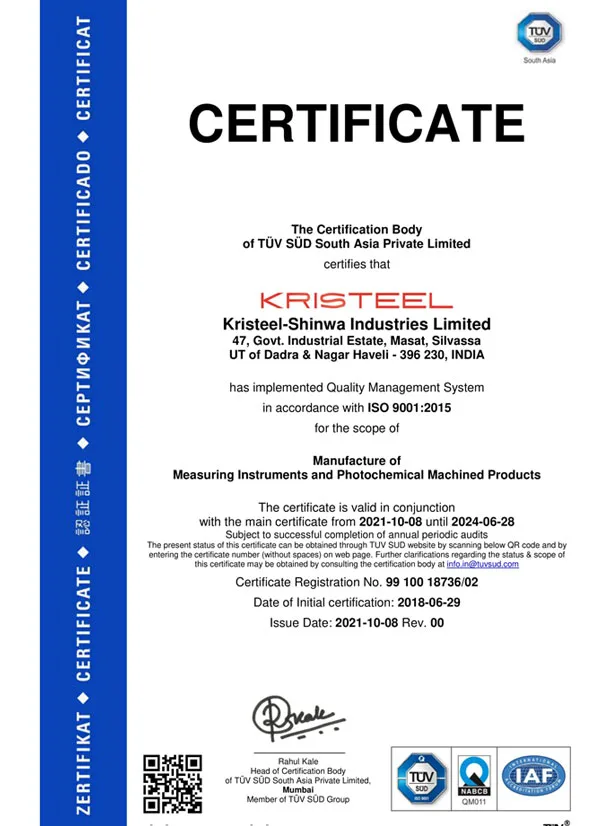
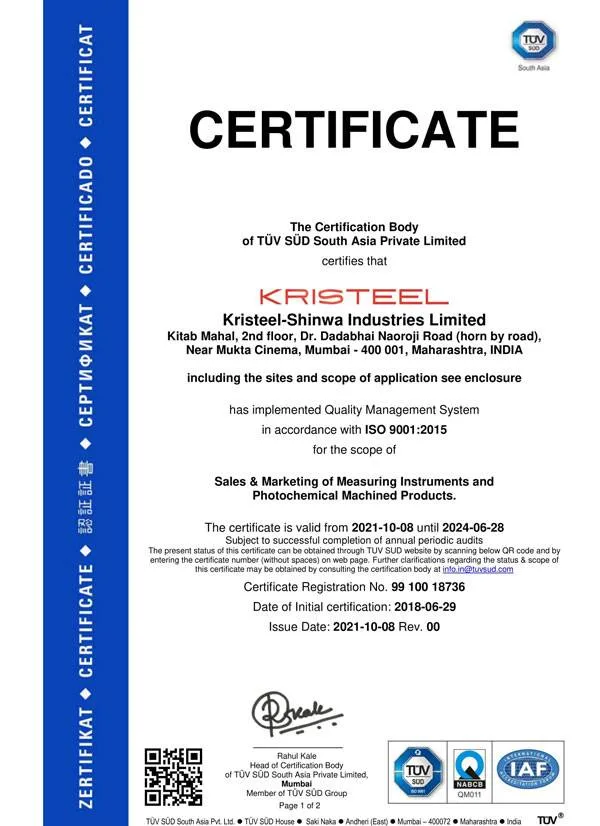
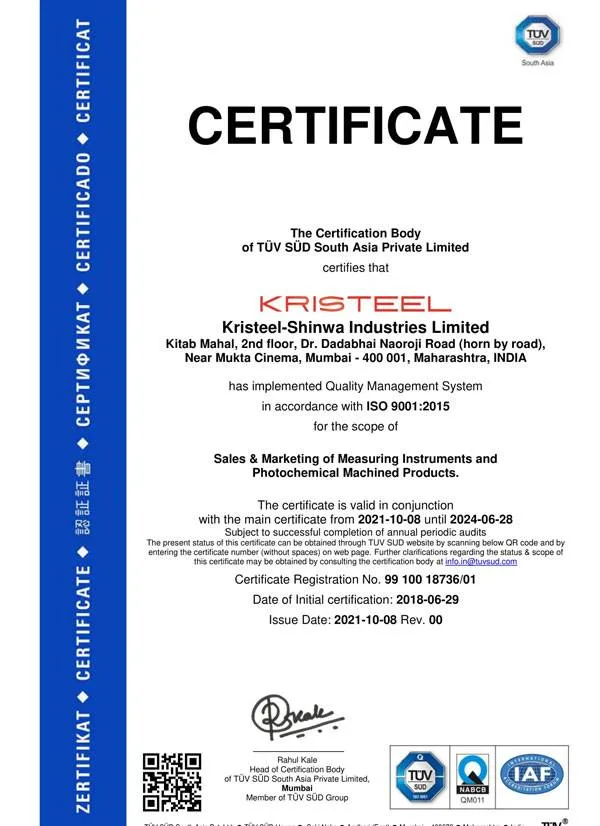
- ✓ISO 9001:2015 certified manufacturing in Silvassa and Bangalore with full batch traceability and certificates of conformance on request.
Capability Specifications
Key parameters for tab terminal manufacturing.
Surface Finishing
Plating Options for Tab Terminals
Plating on a tab terminal is not cosmetic — it directly controls contact resistance at the mating interface, corrosion protection of the brass substrate, and solderability if the terminal is to be wave-soldered. Kristeel maintains in-house plating for two specifications.

Tin (Sn) Plating
In-House · RoHS Compliant
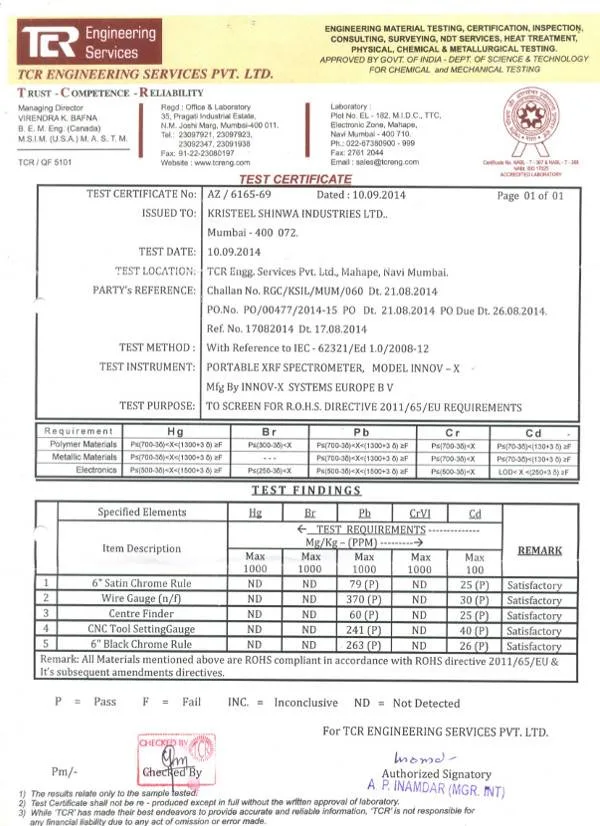
Matte tin is the industry-default plating for tab terminals globally — RoHS compliant, solderable, and provides stable low contact resistance over the product’s service life.
Applied in Kristeel’s own plating facility over a nickel barrier underplate — the nickel layer prevents copper diffusion from the brass substrate into the tin, extending the effective service life of the contact surface.
Plating thickness for tab terminals typically 3–8 μm matte tin; Kristeel controls this per batch with dimensional checks and pull-test verification of plating adhesion.
Compatible with all standard crimp tooling — tin plating does not affect crimp height or wire grip in correctly set crimping dies.
Nickel Silver (NS)
In-House · Natural Finish
Cu-Ni-Zn alloy applied as a surface treatment or used as the base material — provides a bright silver-white appearance with natural corrosion and tarnish resistance without additional plating.
Preferred for instrumentation, smart metering, and industrial terminals where a tin-free metallic surface is specified. Kristeel has in-house NS processing shared with RF shield and battery terminal production.
Can be combined with selective tin plating on the contact face of the tab only — providing the corrosion-resistance of NS on the body with optimised contact properties on the mating surface.
Consistent batch-to-batch quality from Kristeel’s in-house facility — no delays from external plating subcontractors.
Silver (Ag) & Nickel (Ni)
Via Partners — Available
Silver plating provides the lowest contact resistance of any common finish — specified for high-cycle connectors, high-frequency signal contacts, and defence or aerospace applications where contact performance must be guaranteed over extended service life. Available via Kristeel’s external plating partners.
Electrolytic nickel provides a hard, wear-resistant surface with excellent corrosion resistance at elevated temperatures — used for tab terminals in engine bay automotive applications and industrial contacts where operating temperature exceeds tin’s practical range.
Discuss silver or nickel plating requirements with Kristeel’s team — we will confirm specification, thickness, and schedule with our established plating partners.
Manufacturing Process
From Drawing to Tape-and-Reel
Kristeel manages every stage of tab terminal production in-house — DFM review, prototyping, progressive die stamping, in-house plating, and tape-and-reel packing. Single-source accountability at every step.
01
DFM Review
Customer drawing reviewed for crimp barrel geometry, tab chamfer angle, minimum bend radii, material temper compatibility, and plating coverage into internal barrel surfaces. No-charge review before any tooling commitment.
02
PCM Prototyping
Prototype tabs produced via photochemical etching — no hard tooling cost, low minimum quantity, fast turnaround. Allows contact resistance testing, fitment verification, and crimp barrel validation on actual material.
03
Die Stamping
Progressive die tooling built in-house. High-speed auto-feed presses stamp from coil stock — blanking, piercing, forming, and crimping wing geometry in a single pass. Dimensional checks at set-up and during production.
04
In-House Plating
Tin or nickel silver plating applied in Kristeel’s own facility. Plating thickness measured per batch. Adhesion verified by tape peel test and bend test. Full batch traceability maintained throughout.
05
Packing & Dispatch
Parts bulk-packed or loaded into EIA-481 carrier tape for tape-and-reel delivery. Visual inspection for plating coverage, burr condition, and dimensional conformance. COC and material certs issued on request.
Packing & Delivery
Ready for Your Assembly Line
Three packing formats matched to your production process — from first prototype through to high-volume automated harness production.
01
Loose / Bulk Pack
Terminals packed loose in poly bags or trays for manual crimping operations, prototype assembly, and low-volume production. Quantity and batch labelled. Suited to workshop assembly, repair operations, and engineering evaluation.
02
Strip / Chain Pack
Terminals supplied connected on a carrier strip as formed during progressive die stamping — the format required for semi-automatic bench crimp presses. Feed strip pitch matches your crimping machine specification. Reeled for continuous feed.
03
Tape & Reel (EIA-481)
Industry-standard carrier tape and reel format for direct loading into automated wire-processing and pick-and-place equipment. Pocket dimensions, cover tape peel force, and reel format confirmed to your machine specification. Eliminates manual loading on high-speed harness lines.
Common Questions
Frequently Asked Questions
Questions most frequently asked by harness engineers, procurement managers, and OEM design teams evaluating tab terminal suppliers in India.
Does Kristeel supply tab terminals in standard series sizes (2.8, 4.8, 6.3, 9.5mm) or only custom?
Can Kristeel supply tab terminals in tape-and-reel for automated harness production?
What is the difference between 2.8mm, 4.8mm, 6.3mm, and 9.5mm tab terminals?
Does Kristeel supply female receptacle terminals as well as male tabs?
Can Kristeel supply prototypes before we commit to production tooling?
What information do I need to share to get a quotation?
Send your tab terminal drawing.
Samples within days.
Photochemical etching means no tooling cost and no minimum quantity for prototypes. Share your drawing, wire gauge, and volume requirement — our team will review and respond with a quotation for both samples and production within two business days.