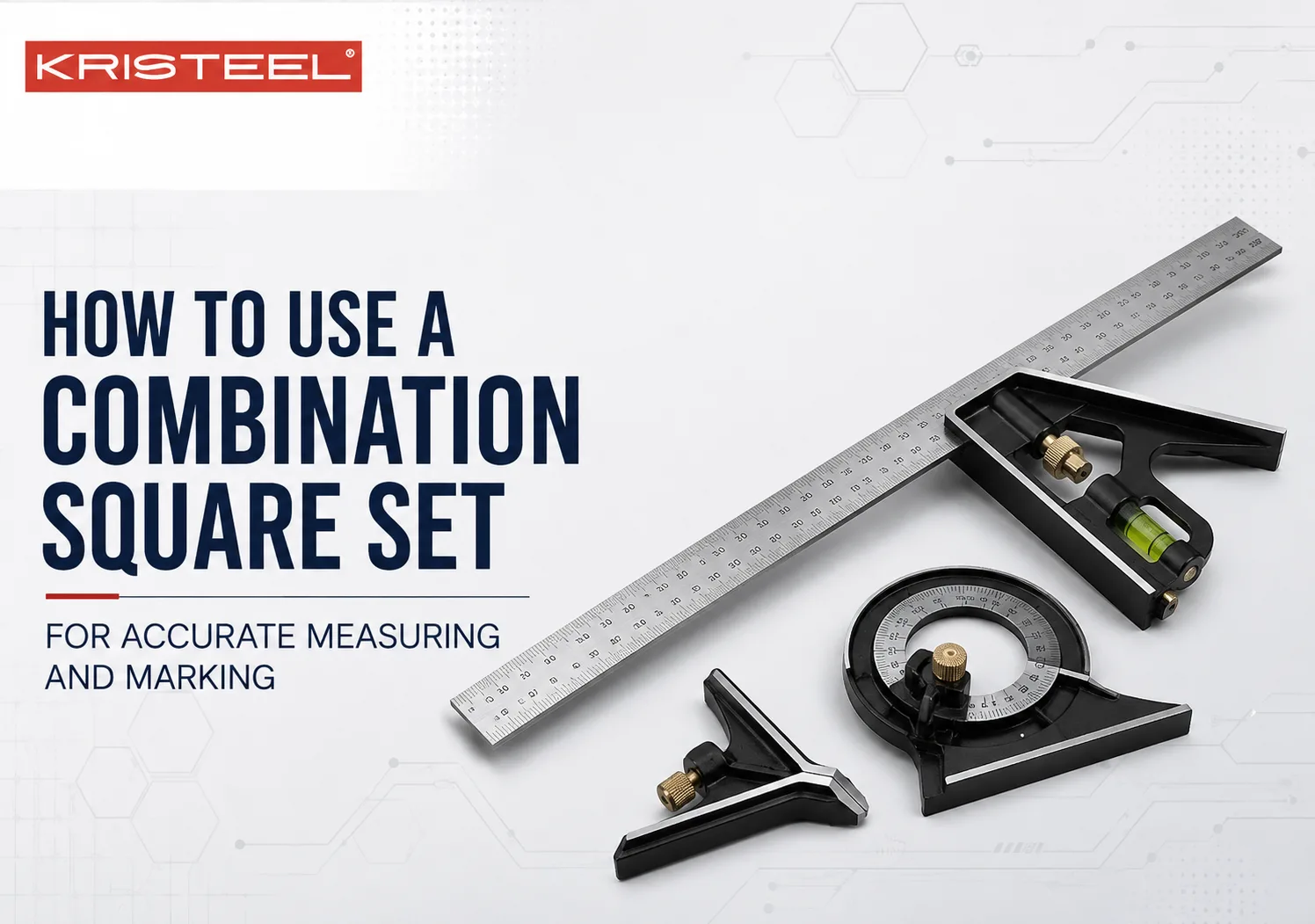
Using a combination square set correctly helps to achieve accurate measuring and marking across woodworking, metalworking, and fabrication. A cut that’s off by even a millimeter can throw off an entire joint, weld, or assembly down the line. Among the tools that make accurate measuring and marking possible, a combination square set stands out as one of the most versatile options on the bench, combining several measuring functions into a single, adjustable instrument. Getting comfortable with it pays off directly in project quality, since accurate layout work reduces material waste and cuts down on rework before a single cut gets made.
What is a Combination Square Set?
A Combination Square Set combines a graduated steel rule with interchangeable heads, allowing the same rule to perform several measuring, marking, and layout functions.
Components of a Combination Square Set
A standard combination Square includes a steel rule, a square head, a protractor head, and a center head. Some configurations also add a scriber and a built-in spirit level for checking surface flatness alongside angle and length measurement.
How Each Component Works
The steel rule handles straight-line length and depth measurement, usually graduated in both metric and imperial scales. The square head locks onto the rule to check and mark 90° angles, while many heads also include a 45° face for miter work. The protractor head rotates to measure and mark custom angles, often across a full 0 to 180 ° range. The center head locates the exact center of round stock, a function the other heads can’t replicate. Blades are typically hardened steel, finished to resist wear from repeated marking and handling.
Step-by-Step Guide to Using a Combination Square Set

Step 1: Inspect and Clean the Tool
Before taking any measurement, ensure that the rule and the head are clean and free of dirt, rust, or damage. A dirty or damaged edge will introduce inaccuracy long before the tool ever reaches the workpiece.
Step 2: Adjust the Square Head
Place the square head on the rule as required, and then firmly tighten the locking screw, ensuring it is snug under a little pressure before you continue.
Step 3: Measure Length Accurately
Align the rule against the workpiece edge and read the scale at eye level. This positioning reduces parallax error for an accurate measurement.
Step 4: Mark Straight Lines
Mark a neat continuous line on the edge of the square with a scriber or pencil using the square head as a straightedge.
Step 5: Check 90° and 45° Angles
Compare corners and joints to the reference edges on the square head before making a cut. Catch the misalignment early when it’s easier to fix.
Step 6: Measure Depth and Height
The square head has a face that provides a level reference surface. Insert the rule into a groove or hole and read the depth immediately from the scale.
Step 7: Find the Center of Round Materials
Put the center head on the rule and place both arms against the round stock. The edge of the rule will then run straight through the centre point to be marked.
Step 8: Measure and Mark Angles
Swing the protractor head round to the angle required, clamp it in position, and use the edge of the rule to scribe the layout line exactly where required.
What Is a Combination Square Used for?
There are multiple uses of a combination square, such as to cover, measure, and mark 90° and 45° angles; check the squareness and flatness of workpieces; measure depth and height; find the centre of round bars and pipes; set machine tools and saw blade heights; and mark parallel lines with precision.
Common Applications of a Combination Square
Woodworking
Marking joints and checking squareness before assembly keeps furniture and cabinetry pieces fitting together cleanly.
Metal Fabrication
Layout work before cutting and welding relies on the tool’s accuracy to keep finished assemblies square and true.
Machining
Precision setup and inspection tasks depend on the same reliable 90° and depth references the square provides on the bench.
Construction
Framing, trim work, and alignment checks all benefit from a tool that handles length, angle, and squareness in one compact unit.
Conclusion
A combination square set earns its place as one of the most useful tools across trades precisely because it replaces several single-purpose instruments with one adjustable system. From checking a 90° corner to finding the center of a round bar, the versatility built into this tool saves both time and material by catching errors before they become expensive mistakes.
When choosing a Combination Square Set manufacturer, buyers should look at construction quality, graduation accuracy, head fit, and the materials used. Kristeel manufactures combination square sets with hardened steel construction and clearly graduated scales for demanding measuring and marking applications. Reach out through our contact page to find the right combination square set for your workshop or production floor.